
For the last year and a half, at every bookstore that I’ve entered I have asked the shopkeeper if they have any books on tattoos. On occasion, they’ll show me one or two books, tucked somewhere between the fashion reviews and graffiti art sections. What they have has become unfortunately predictable to me— coffee table photo books featuring the stars of InkMaster or their western machine artist contemporaries, classic glossy photo spreads from old school American Traditional founders, and the occasional “sailor tattoo” themed adult colouring book— none of which are particularly helpful to me as a queer hand poke artist who is interested in colonization within the history of tattoos.
Nevertheless, I’ll take what I can get. So, over the past year, I’ve accumulated a relatively extensive collection on display in my studio, featuring six whole books on tattooing. Whoopee. While I’m proud of my bite sized collection, and encourage many of my clients to peruse from my bookshelf during appointments, I wish that I had more hands on resources to offer when I start talking about the history and science behind tattoos. The lack of literature on tattooing then becomes a discussion itself— and this happens often enough that I’d like to write about it myself.
Writing tattoos– by the numbers
Like any art form, tattooing is better seen and experienced than written about. Like any other art form, it exists regardless of the academics who study it and the writers who intellectualize it. Nevertheless, considering the age and breadth of the practice, the volume of content written on comparable artistic media dwarfs all literature on tattooing. Archeological evidence suggests that tattooing is as old as weaving. In 2019, 30% of Americans had at least one tattoo, while only 23% admitted to attending an art gallery, much less admitted to owning an original piece of painted or sculptural art. While thousands of books, articles, and papers exist on those other art forms, books discussing tattoos are few number and far from diverse in their contents.
Taking a quick peek at the numbers, I find it fascinating to compare the presence of literature on tattooing with some of its sister art forms who share central practical elements. Weaving is as old as tattooing, its tools tend to outlast their creations, and it also is worn about the body; embroidery is similar to weaving, but, like tattoos, it is not so much functional for survival purposes as it is ornamental and social; graffiti is as publicly visible and conversationally engaging as tattoos in many circumstances, plus it shares a history of criminality and other stigma; finally, painting is widely considered to be an essential form of “high art” in our society, so it provides a fruitful point of comparison into what the western world considers “art” and “not art”.
Number of search term hits by database:
| Google scholar | WorldCat (books only) | Amazon Books | Library of Congress | Vancouver Public Library | Indigo Books | Barnes & Noble | |
| tattooing | 79,100 | 22,000 | 20,000 | 5,650 | 303 | 59 | 59 |
| loom weaving | 126,000 | 58,000 | 10,000 | 16,136 | 582 | 1109 | 707 |
| embroidery | 218,000 | 37,000 | 30,000 | 11,036 | 714 | 1374 | 770 |
| graffiti | 471,000 | 26,000 | 50,000 | 481 | 199 | 913 | 588 |
| painting art | 2,780,000 | 640,000 | 60,000 | 39,202 | 4184 | 10159 | 1276 |
Across the board, tattooing is written about and distributed less than other art forms. In the world of academia, Google scholar illustrates the relative scarcity of published research and intellectual discourse. Worldcat and Amazon provide a good picture of exactly how many titles have been published on these art forms. Most fascinatingly, while libraries do stock books on tattooing, private bookshops like Indigo and Barnes &Noble reveal that very few of these books actually sell in their stores, meaning they do not make these companies significant profits from private buyers in the general public.
So, what exactly is out there?
Let’s take our analysis one step further and examine the content of tattoo literature across the same platforms. A quick scroll through my Google Scholar search turns up mostly medical literature about the risks, complications, removal procedures, and degenerate behaviour patterns linked to being tattooed. More specific queries have led me to find more interesting and less classist research into the history of tattooing, but searching through google’s database usually means sifting through a mountain of heavy scientific jargon generally positioning tattoos as a health problem instead of a social phenomenon. While much of this is fascinatingly problematic, and a wonderful topic for a future blog post, academic literature databases are not where most people go to learn about tattoos.
The library certainly seems like a more democratic alternative for finding content written about tattoos in more accessible language. While library loaning systems demonstrate their own challenges to borrowers, in my personal experience they can help me to find books on tattooing and read through them within a month or so before I have to return them. I have liberally taken advantage of Vancouver Public Library’s holdings, and have learned a lot in doing so. However, as an artist, I want books that I can keep on my shelves to reference in future conversations, and a library loan doesn’t fulfill that need.
Of course, when I want to purchase a book that I can learn from, keep, and reference later, my options are often as expensive as they are limited. In my experience, the books that sell are coffee-table books, with no more than a few pages of writing followed by the occasional paragraph punctuating a stream of glossy, gorgeous, and minimally captioned photographs of tattooed people. They’re easy books to flip through in a waiting room, and they don’t offer much information about the subjects of the photos, the artists’ backgrounds, the techniques used, or the personal meanings behind the artistic choices. These books are not for people who are considering getting tattoos, nor are they compiled for artists to learn about tattooing. They are made for collectors, and they are published to be displayed instead of discussed.
Honourable mentions
I want to clarify that my frustration with the current state of tattoo writing lies chiefly in the distribution, not the creation of quality literature. I am frustrated at how difficult it is to find teaching tools that discuss the details of how tattoos are and came to be, and I am annoyed by the types of publications which are deemed profitable enough to mass produce and sell in regular bookstores. The books I tend to find, which contain only work from machine tattoo artists primarily in western nations, are not the only tattoos that exist right now and have continued to exist throughout the past few millenia. While there is certainly beautiful artwork in these modern bold lined and colour packed machine tattoos, they do not represent tattooing as a whole. Yet their work being the only “publishable” art leads the general public to believe that this is the “proper” way of doing tattoos, which is not only problematic, but deeply untrue.
Aside from what you’ll find in your neighbourhood bookstore, there are still books on tattooing that I personally find much more fascinating as a reader and helpful as an artist. These books don’t just present raw images of tattoos and brief summaries of American Traditional history– they encourage their readers to continue learning about tattoos by providing adequate bibliographies and references for the photos that they display. While I don’t yet have the means to own all of these books, many are available from the public library and the rest are on my wish list.
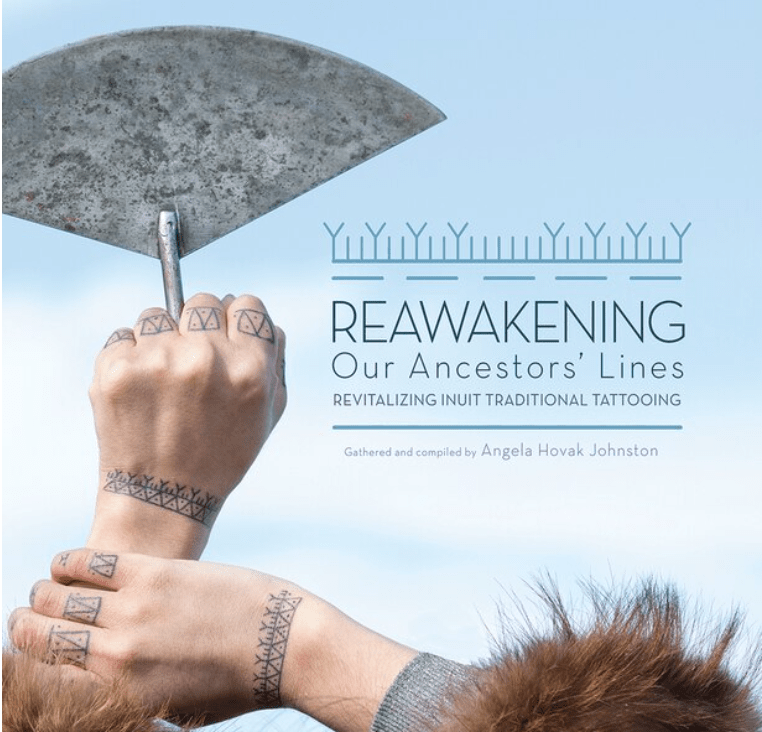
“Reawakening Our Ancestors Lines: Revitalizing Inuit Traditional Tattooing”
by Angela Hovak Johnson, 2017
This short but incredible read documents the work of Angela Hovak Johnson, who started a project in 2008 to revitalize traditional tattoo practices among Inuit women in Nunavut. The book documents a brief history of settler colonization amongst Inuit and discusses the ways that missionaries and residential schools sought to eradicate their tattoo traditions. She documents her journey of becoming a tattoo artist and adapting her ancestors’ traditions to serve her contemporary community. It shares many features with other coffee-table tattoo books in its sparse yet accessible writing, its high quality photography, and lack of cited references, but puts its companions to shame with the rich, meaningful, and impactful work that it documents.
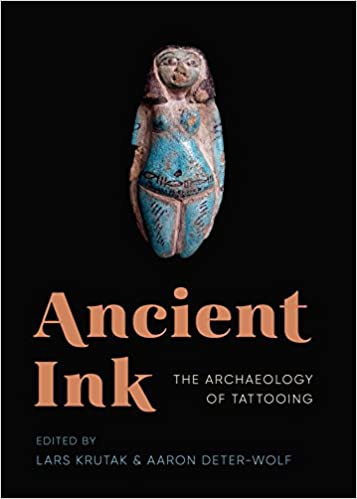
“Ancient Ink: the Archeology of Tattoing”
edited by Lars Krutak & Aaron Deter-Wolf, 2018
A personal favourite of mine, Ancient Ink collects and presents the archeological research of multiple writers across the world, including the work of the editors. The few dozen articles go over the tools, designs, living traditions, and tattoo revival efforts happening in the field. More academic than artistic, and more ethnographic than theoretical, it makes a good read for nerds like me. It is thorough and broad in scope, but the language is often dense, dry, and academic with sparse photographic support.
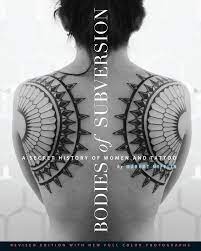
“Bodies of Subversion”
by Margot Mifflin 1997
Mifflin’s thrice revised book contains an excellent balance of feminist historical and ethnographic writing paired with extensive, though not particularly novel, photographic support. Mifflin walks through the last century and a half of tattooing in women from Europe to America as machine tattooing crested its masculine rise, exploiting and then empowering women throughout the 20th century. Its exploration of feminine bodily autonomy in tattooing is riveting, though it does fall short in its ability to push beyond the limits of white feminism.
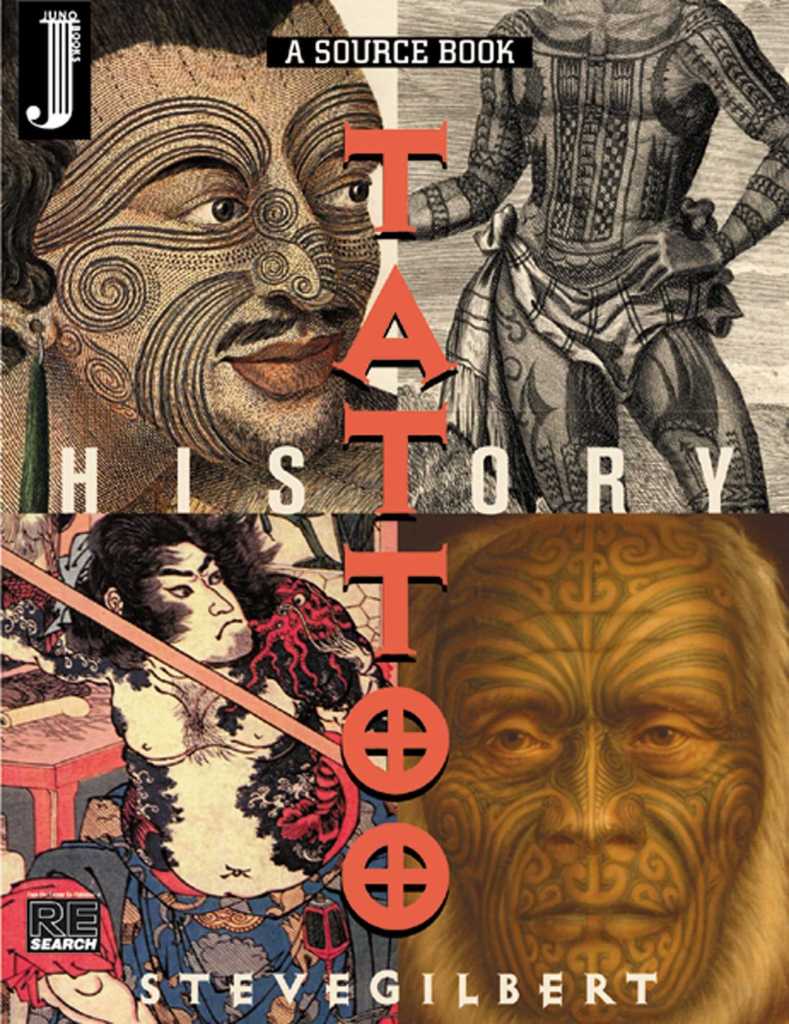
“Tattoo History: A Source Book”
by Steve Gilbert, 2000
Gilbert’s anthology is relatively comprehensive in its coverage of global tattoo histories. It pulls from a wide range of archival findings including interviews, primary sources from early anthropologists, as well as contemporary artists to create a thorough yet readable introduction to the history of tattooing across several global regions. Unlike other books which print the same drawings and photographs, Gilbert provides adequate citations, a significant bibliography for further reading, and a relatively balanced amount of accompanying writing. However, not much critique is offered to explain the role of European colonization within the historical archives from which Gilbert sources his content. So, the plethora of racist first hand accounts from settlers in this book are as revealing as they are taxing to read.

“Queer Tattoo”
by Andrew Burford & Stewart O’Callaghan, 2022
Admittedly, my copy of this book has yet to arrive in the mail from Germany, but I’m so looking forward to reading this book. It describes itself as an artist centred book, celebrating the work of over 50 queer tattoo artists worldwide (including some right here in Vancouver). I appreciate their intention to celebrate the artists as people contributing to a larger social movement, and I genuinely hope that this book will also provide some background history on queerness and tattooing as well as resources for further discovery. Until then, I’m just excited that this book exists.
Why does writing about tattoos matter?

Art can and certainly does exist without the literature that discusses it. However, writing fosters artistic literacy, for artists and witnesses alike, such that anyone can gain perspective into the breadth and depth of a given medium. In intellectualizing it, writing legitimates art as something valuable to document and valuable to engage with.
Writing published for the archives is one thing, and writing published for the masses is another. Clearly, there are people out there who care about tattoos in similar ways to me, who write books and papers to be published in small firms and distributed in libraries where cunning people can borrow them. However, the “free” market is such that the books that sell must fit consumers’ demands for brevity, aesthetic pleasure, and familiarity, making sure to push people only so far out of their comfort zones so that they feel stimulated, not overwhelmed. This further reiterates what content— in this case which tattoos— are acceptable for public discussion.
 Andy Pollard