Readings & Resources

Handpoked Art, Research, and Musings
American History
Archeology
Archives & Collections
Colonization
Dermatology
Feminism & Gender Studies
Global Traditions
(by region)
Immunology
Law & Legislation
Mass Media
Methodology
Psychology
Queer Studies
Style Guides
Trauma Informed Tattooing
Western Religion
Colour tattoos
On This Page:
The Science:
NOTE: The majority of biological research on tattoos is conducted by and for medical professionals in the laser tattoo removal industry. As such, the scientific discourse focuses on improving these removal methods, not improving the design practices of tattoo artists.
Read my Dermatology 101 blog post series to learn more about what science can prove helpful to tattoo artists
Pigment Sizes & Microscopy:
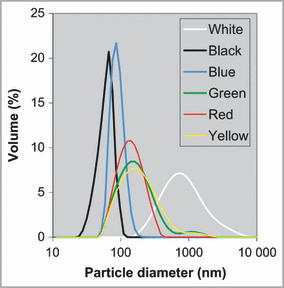
Tattoo Inks In General Usage Contain Nanoparticles:
- This article offers the explanation that black and blue ink is most effectively removed in laser treatments as the particle size is both smallest and most consistent, whereas other colours have generally larger pigment sizes and a wider size range to address.
- “The size of the pigments could be divided into three main classes. The black pigments were the smallest, the white pigments the largest and the coloured pigments had a size in between the two”
- T. Høgsberg, K. Loeschner, D. Löf, J. Serup, Tattoo inks in general usage contain nanoparticles, British Journal of Dermatology, Volume 165, Issue 6, 1 December 2011, Pages 1210–1218,
- https://doi.org/10.1111/j.1365-2133.2011.10561.x
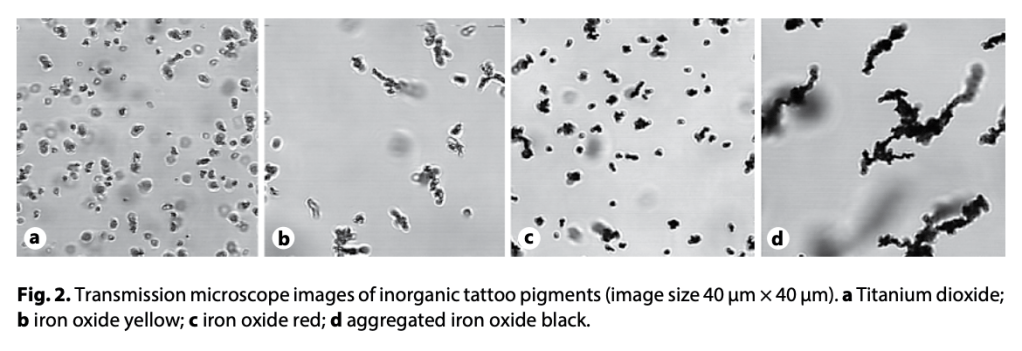
Tailored Surface Engineering of Pigments by Layer By Layer Coating
- Organic and inorganic chemicals used to create the base pigments of yellow, blue, red, black, and white behave differently in terms of photodecomposition and metabolization.
- “Several factors determine the instability of pigments in the skin, such as dissolution, chemical degradation, photobleaching, and enzymatic degradation by the phagocytes of the immune system.”
Pigment Behaviours (by colour):
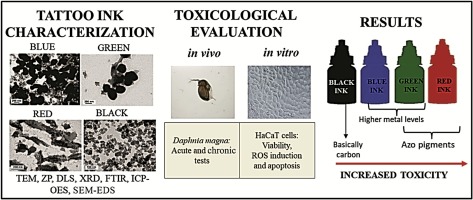
RED:
- Red ink is the leading culprit of allergic reactions in tattoos (Serup, 2019)
- Allergic reactions to red ink include contact dermatitis, but also include more serious potential reactions of inflammation, cornification, and necrosis which are only observed in red ink tattoos. (Dahne et al 2015)
- Photodecomposition from solar or laser radiation leads to pigment reductions of up to 60% (Jemec, 2005)
- Depending on skin tone, red pigments may lose their vibrance or break down more quickly. The melanin which sits overtop healed tattoos does not shield solar radiation on the red spectrum as effectively. (Bettertattooing)
- Blood and melanin both have red spectrum coloration, which lowers the contrast of red tattoo ink, making it “pop” less.
YELLOW:
- Yellow photodecomposes relatively quickly in the skin. It may also metabolize more readily during healing (Cui, 2005)
- Yellow has the lowest absorption spectrum, making its removal via laser treatment a unique challenge requiring specialized technology. (Hogsberg, 2011)
- Similar toxins are found in yellow ink as in red ink. (Dahne et al 2015)
- Similar to red, yellow inks appear to fade and lose vibrance more quickly due to low contrast against yellow coloration present in melanin and warm/neutral undertones.
BLUE:
- Blue pigments are more uniform and smaller than other colours, meaning they fade and spread less, and are more easily removed in laser treatment. (Hogsberg et al, 2011)
- Allergic reactions may result in a shift towards green (Dahne et al 2015)
GREEN:
- Second most allergic reactions documented (Arl et Al, 2019)
- There is significant variability in the absorption rate of green ink, making aging behaviours hard to generalize (Clarke Beute, 2008)
- Allergic reactions may result in a shift towards blue (Dahne et al 2015)
Laser Removal by Colour:
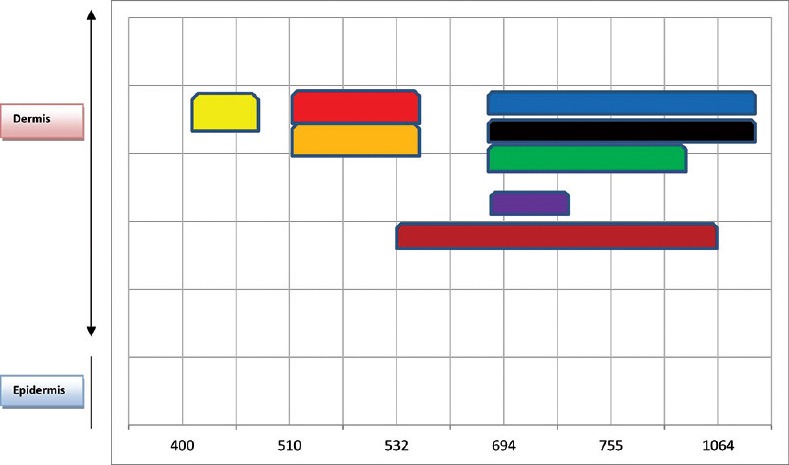
- Laser treatment breaks down particles in a similar manner to solar radiation, i.e. fragmenting individual particles into visually imperceptible pieces. Due to variations in size and consistency, different pigment colours respond to wider ranges of laser frequencies in order to disperse.
- “Though three lasers… are used commonly, as the tattooed pigment comes in a wide range of colours, multiple wavelengths of laser light are required to successfully remove tattoos.”
- T. Høgsberg, K. Loeschner, D. Löf, J. Serup, Tattoo inks in general usage contain nanoparticles, British Journal of Dermatology, Volume 165, Issue 6, 1 December 2011, Pages 1210–1218,
- https://doi.org/10.1111/j.1365-2133.2011.10561.x

- This study targeted three of the most common tattoo ink colours and their responses to treatment under pico and nano Q switch lasers. Research was conducted on a guinea pig.
- Choi MS, Seo HS, Kim JG, Choe SJ, Park BC, Kim MH, et al. (2018) Effects of picosecond laser on the multi-colored tattoo removal using Hartley guinea pig: A preliminary study. PLoS ONE 13(9): e0203370. https://doi.org/10.1371/journal.pone.0203370
Skin & Colour:
Colour tattoos look different depending on the skin they inhabit. The following are resources for better understanding the characteristics of skin that affect the final healed look of tattoos, such as base colour, undertone, and complexion.
Tone & Complexion:
“Skin colour is the BASE of your skin
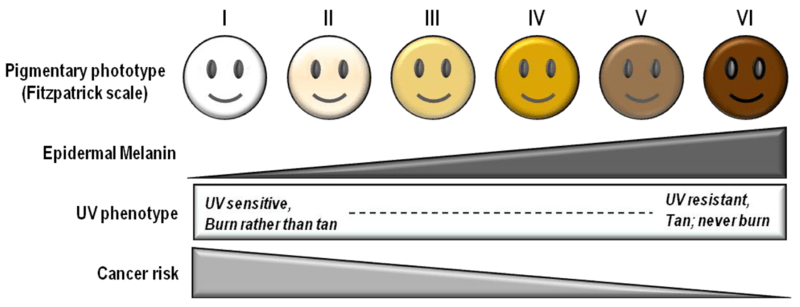
- This is what color we normally associate with our genetic (phenotypic) makeup. Tattooers are ford to identify the base of a person’s skin to determine best techniques for design creation and application. Terms like light skinned or dark skinned are used commonly to describe a person’s BASE. It is created by the quantity of melanin producing cells located in the skin.
“Skin Tone is the TINT of your skin
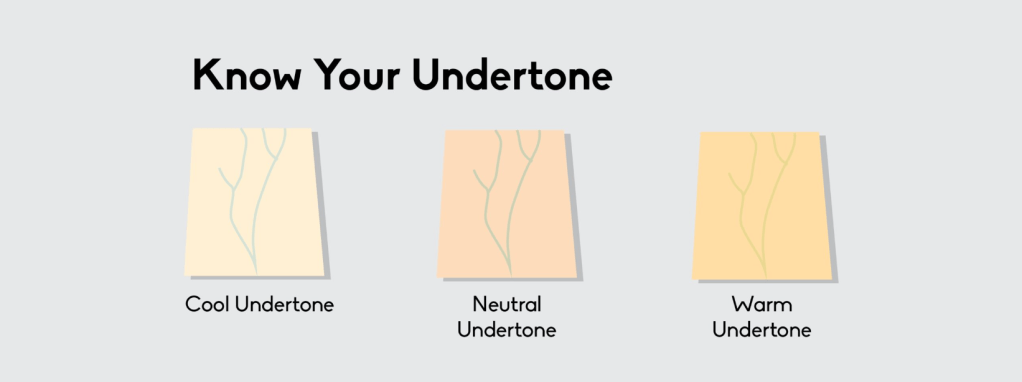
- Also known as undertones, skin tones are the result of UV rays forcing your skin to produce melanin (the main constituent of your skin BASE) to protect itself from damage. The way this melanin filters natural light adds a TINT to your skin BASE. This aspect of skin coloring is made up by the filtering ability of melanin in the skin – which wavelengths of light are reflected versus absorbed.
“Skin Complexion is the texture & appearance of your skin.
- Skin COMPLEXION is how the skin feels. Touch sensory questions like, “How does the skin feel” are best at describing COMPLEXION.
SOURCE: Skin Colour, Tone, and Complexion: What This Means For Your Tattoo
Colour and Melanin
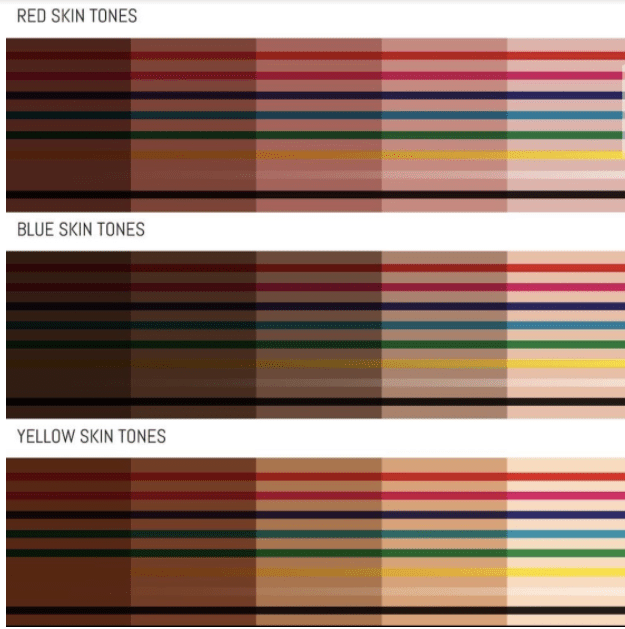
Guide for Tattooing Darker Skin Tones:
“It helps to think of skin as a filter made up of many translucent layers. When ink is injected into a person’s skin, the healed tattoo will be viewed through those layers. The more melanin a person has, the darker those layers are, and depending on the tattoo… the more challenging it may be to see the finished product. “
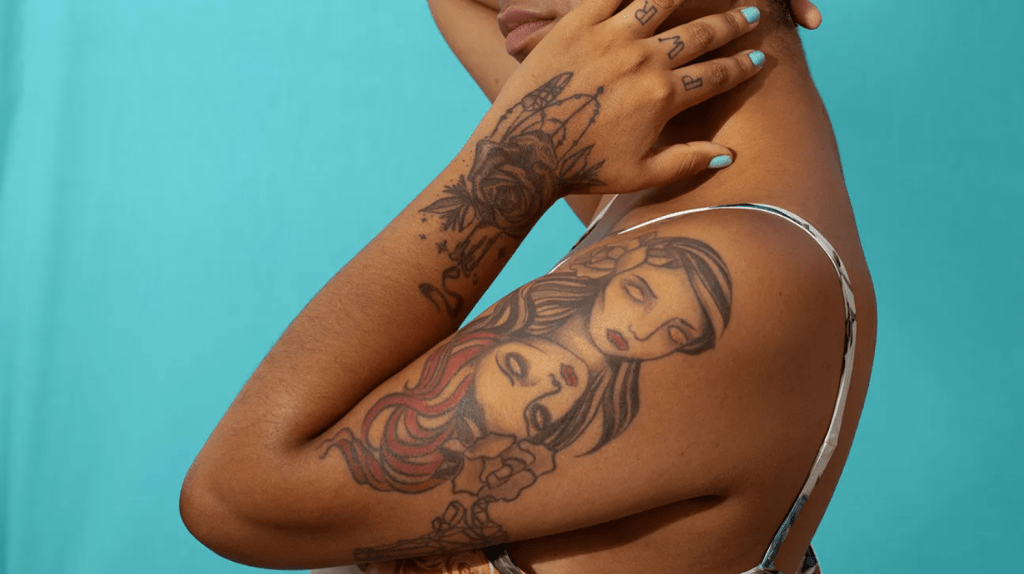
Color Tattoos on Dark Skin Tones: What You Need To Know— Healthline
“Here’s what two tattoo artists with nearly 60 years of professional experience have to say about getting the best tattoo for black or brown skin:
- Find an experienced artist
- Know your skin
- Think about aging
- Consider details
Artists’ Perspectives:
Colourism:

Black and White, but White All Over: Colourism in the Tattoo Industry
- “ the industry reflects and perpetuates systemic racism and white supremacy through the imagery on tattoos, photographs of tattoos, and the apprenticeship of tattooists. But questioning the history of the tattoo industry and applying anti-racist practice can help tattooists expand their skill set, and help clients hold them accountable. “
- Anna Moyer, Spring Magazine, 2021
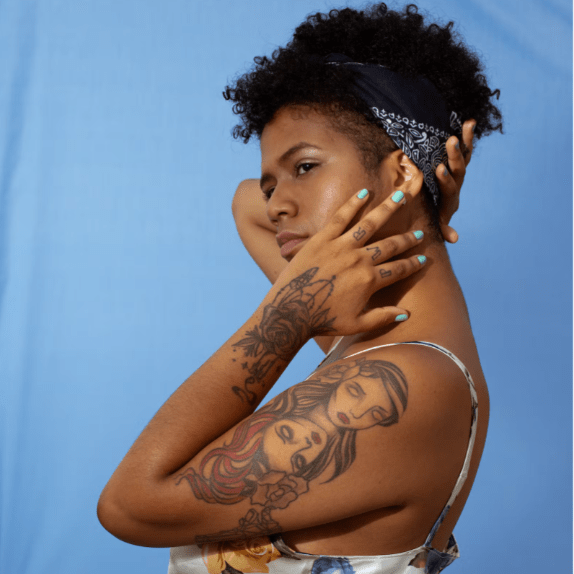
6 Black Tattoo Artists Unpack the Most Common Myths About Tattooing On Darker Skin
- “Going deeper without cause, repeatedly, and in the same area can cause unnecessary trauma to your client both physically and emotionally. This type of myth in tattooing uses the same mechanisms as scientific racism in the medical industry. There is no pathology associated with Blackness and the characteristics of the Black body that would call for needles to breach the normal threshold of where a tattoo should exist within the layers of skin.”
- “It’s very easy for people to say that you can’t tattoo colors on darker skin tones but it depends on the circumstance. Just as shades of skin vary amongst people of color, so do the results. Blanket statements like that can make people feel nervous and that it’s completely not an option for them when that isn’t necessarily the case. It takes an understanding of what colors work best and of how that particular skin tone usually responds to colors-and the professional experience behind that. The exploration of colors on darker skin tones shouldn’t be suppressed”
- Tamara Santibanezz, Bustle, 2019
Instagram accounts:
Pain
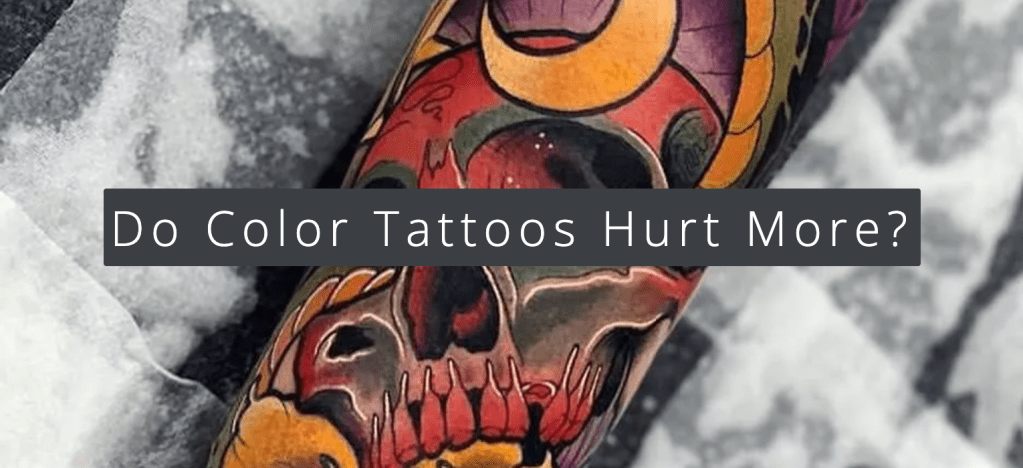
Do Colour Tattoos Hurt More?
“It used to be that colored ink was slightly thicker in consistency than black or gray tattoo ink. This consistency would affect the pain felt as it would’ve taken longer to pack the colored ink, which is a painful experience in the first place. However, all tattoo inks are now made to a similar consistency, so there shouldn’t be an issue.”
“Many people say that the linework doesn’t hurt as much as the shading or color packing, and this may also explain why they think color tattoos hurt more.”
“When you’re getting a tattoo with different colored ink it will generally take longer to complete than a small black and gray tattoo. Your tattoo artist will also change the needles on their tattoo machine to complete the different tattoo styles.”
Design Considerations:
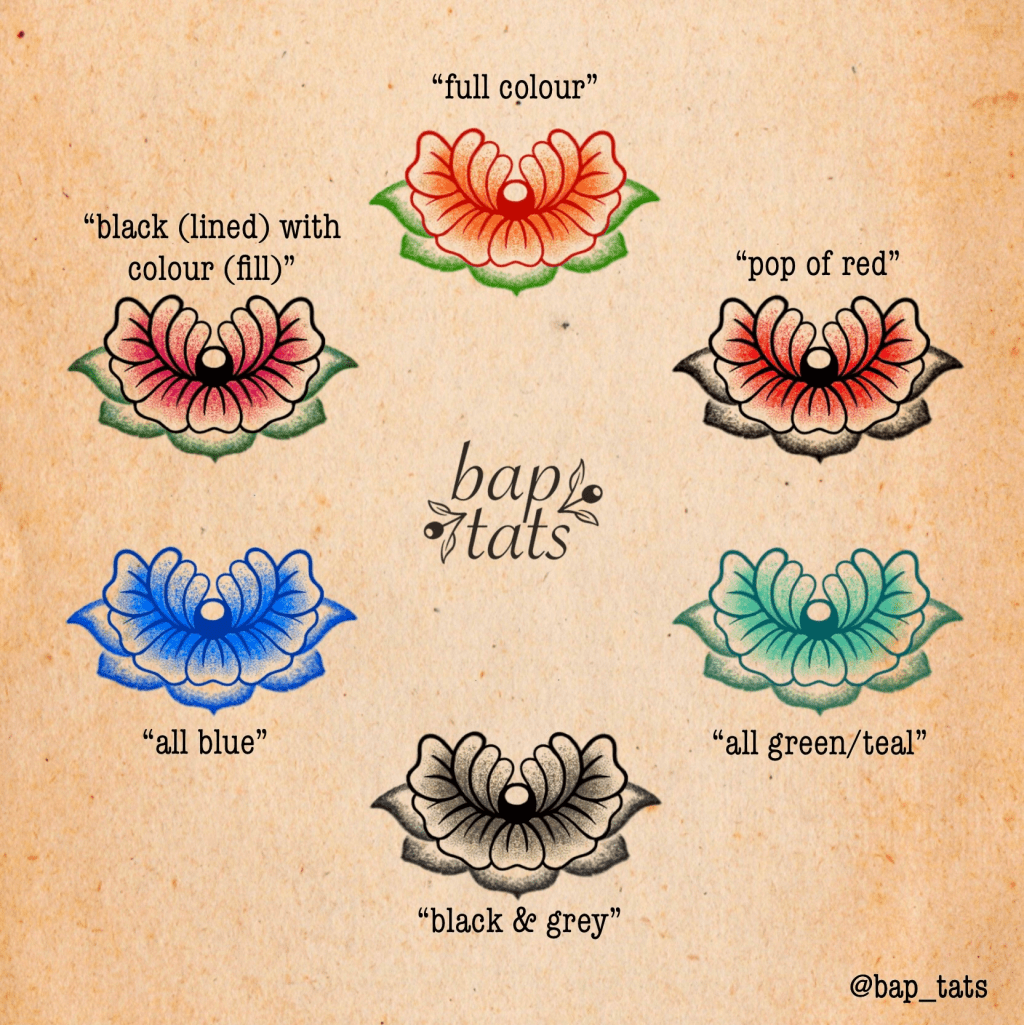
How to talk to your artist about colour:
Which colours work best for tattoos?
- “Yellow, green, and orange pigments are the most resistant to laser tattoo removal… In general, vivid, non-organic colours are the hardest to have removed. White ink fades the fastest, so this pigment will require the most frequent touchups “
- “Black and blue pigments are generally tolerated the best in your skin: they’re easily taken up, and they’re removed with the least effort. People with fairer skin will show more tattoo pigment, whereas people with darker skin will require a higher concentration of pigment”
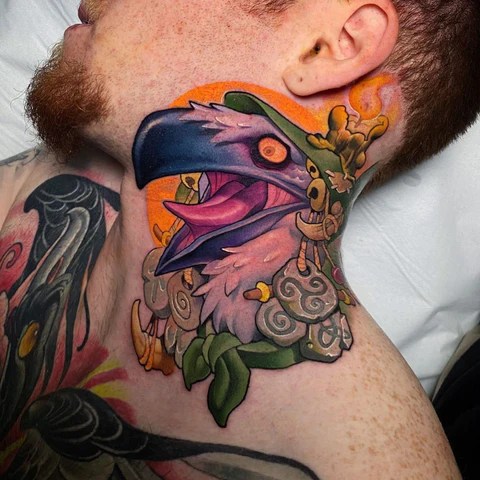
What Tattoo Colours Last the Longest Without Touch Ups?
Black and gray:
Black and gray inks are the boldest and most dense; thus, they are the most fade-resistant colors. These are suitable for any skin tone, especially with tan or black skin. With proper aftercare, black and gray colors last for up to 10 years or longer before requiring a retouch.
Dark blue:
Like black ink, dark blue tattoo colors are suitable for dark skin. They have long-wearing pigments and can also last for up to 10 years.
Red, orange, yellow, and purple:
These tattoo colors fade faster on light skin and are more crucial to working with sensitive and freckled skin. They generally last for about eight years or longer before requiring a retouch.
Pastel colors and white:
These are the lightest tattoo colors; thus, they fade the quickest among all colors. They generally last for about five to eight years before fading. Moreover, pastel and white ink colors may look like scars if not done correctly.
‘Glow-in-the-dark’:
UV tattoos are trendy since they appear fluorescent with UV light. However, they do not last as long as the other tattoo colors. Most tattoo artists say that glow-in-the-dark tattoos can last for three to five years before starting to fade”
Cost
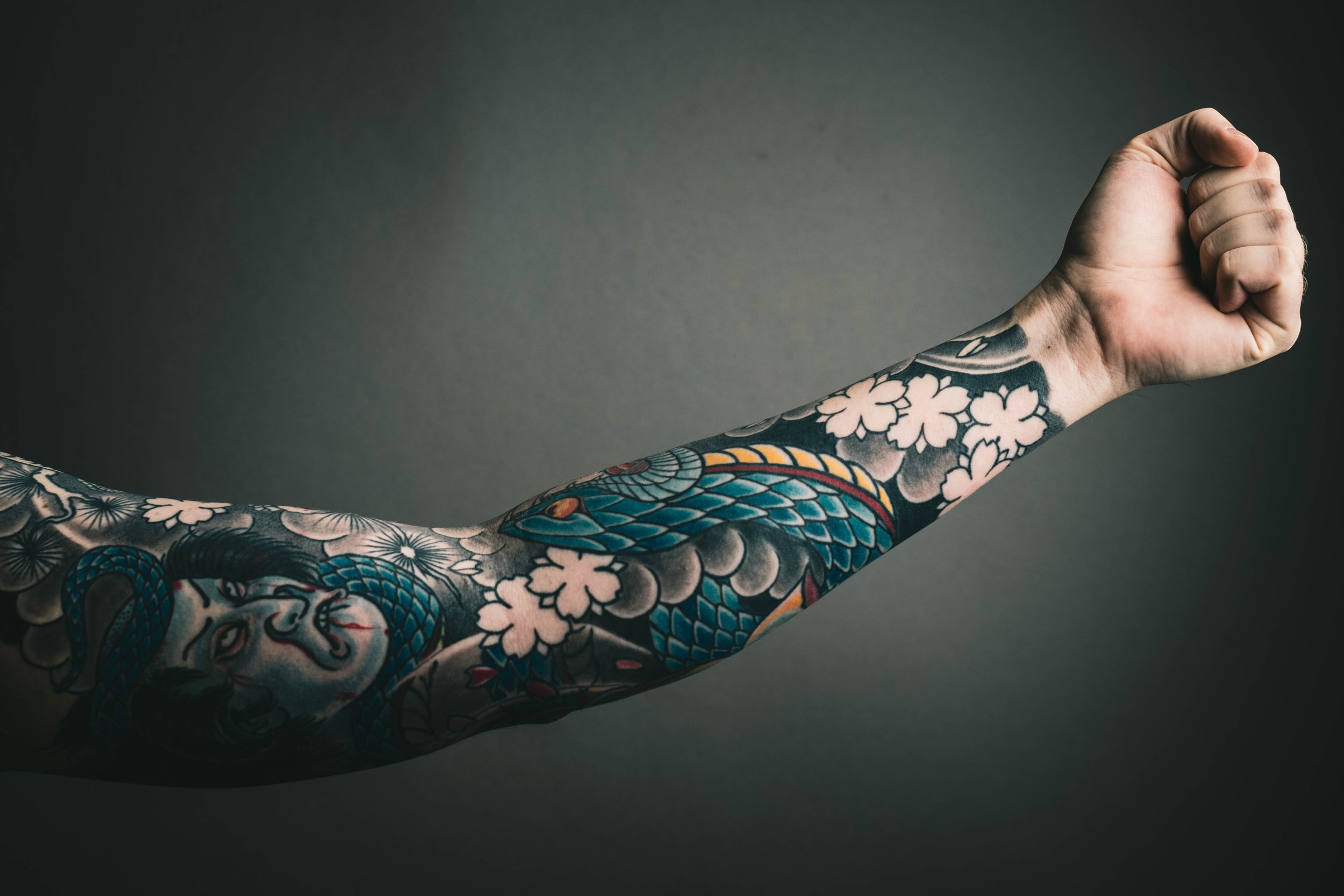
Factors that Influence the Cost of Colour Tattoos
“1. The size of the tattoo.
Obviously, a larger tattoo will cost more than a smaller one. But did you know that the location of the tattoo can also affect price? Geometric watercolor tattoos on the arms or legs tend to be less expensive than those on the hands, feet, or face.
2. The complexity of the design.
A geometric watercolor tattoo with a lot of detail will take longer to create and will therefore be more expensive than a simpler design.
3. The number of colors used.
If you want a geometric watercolor tattoo with a lot of color, be prepared to pay more. Tattoos with fewer colors will cost less.
4. The artist’s experience and reputation.
If you want your geometric watercolor tattoo done by a well-known artist with lots of experience, it’s going to cost more than if you go to someone who is just starting out.”
Colour in Society:
Chromophobia
Chromophobia (Book by David Batchelor)
“According to Western colonial aesthetics, whiteness is whereas color does. Therefore, color must be controlled, classified, and contained.
“Scottish artist David Batchelor coins the term “chromophobia” to capture the ways Western psyche seeks to renounce color, homogenize it, remove it of its complexity and depth. He argues that a fear of corruption or contamination from color haunts Western culture…
…Western society has made us associate color with otherness, excess, irrationality, and chaos. Black and white on the other hand is projected as neutral and serious.
According to Western colonial aesthetics, whiteness is whereas color does. Therefore, color must be controlled, classified, and contained.”
-Alok Vaid Menon, Goodreads
Colour Tattoo History

Ancient Egypt:
The first recorded appearance of (non-black) colour tattoos was in ancient Egypt, approximately 5000 years ago. Archeologists found blue indigo and green on the legs and abdomen of a female mummy. Tattoodo, 2020
Greco-Roman:
Pre-Christan Greek and Roman cultures tattooed slaves in order to mark or brand them. Blue and black are well documented archeologically and in writing, and plays from the antiquity refer to additional colours as well. Stigma: Tattoo and Branding in Graeco-Roman Antiquity, 1987.
Yupik-Inuit:
Colonial archives document blue pigments in Yupik and Inuit tattoos (Tunniit) as far back as 1576. Multiple sources note blue facial tattoos amongst Inuit from modern day Alaska to Greenland. Oral histories also document yellow/ochre in tattoos. Lars Krutak, 2012
Pre-colonial indigenous North America:
A 1909 compendium documents colonial reports of tattoo practices of several North American Indigenous peoples. Other than black, blue was the most common colour pigment, and was documented in the tattoos of the Arapaho, Apache, Chippewa, Choctaw, Mattoon, Mohave/Mojave, Sonora, Tlingit, and Yucatan peoples. Settlers also documented Red vermillion in Haida tattoos. Sinclair, 1909 (full pdf)
India:
The Mer people of Gujarat have been using vermillion red, blue, black, and green pigments in their designs for centuries, according to oral traditions and ethnographic research. Lars Krutak, 2009
Pacific Islands:
While traditional Polynesian tattoos are mostly black, blue and green are occasionally present in western oceanic practices. (Lars Krutak )
Japan:
Irezumi, horimono, and tebori Japanese traditional tattoos all integrate colour into their designs. Japanese traditional colours have distinct meanings and uses (read Tattmag’s colour guide). Starting around 600BC, tattoos were mostly black and grey, and occasionally vermillion or cadmium red. In the 17th century, tattoos rose in popularity and multiple vibrant colours including red, green, blue, and yellow quickly became the trademark of Japanese tattoo style (Luca Ortis, ABC Australia, 2016).
America USA:
After the invention of the tattoo machine in 1890, the demand for tattoos skyrocketed, and manufacturers stepped in to supply ink to meet the demand. Red, Blue, Green, and yellow became staples in the American Traditional Style, and tattoo artists would mix the pigment and binders together themselves to make tattoo ink. It wasn’t until the 1950’s that Milton Zeis made and sold pre mixed tattoo ink, and its use didn’t become standard practice until well into the 1970s. (Trinity Tattoo & Piercing, 2016)
Global Trends

European Union Bans Popular Colour Pigments
In 2020, the EU banned the use of several pigments used in cosmetics and tattoo inks, citing public health concerns of cancer risks, allergic reactions, and metal toxicity. In particular, pigments green 7 and blue 15:3 are banned in this controversial decision. While this does not signal the end of colour tattooing in Europe, manufacturers have not been quick to step in with new coloured inks that avoid the banned chemicals. (NPR, 2021, Metro, 2021)
Read European artists’ perspectives on the ban (New York Times, 2022)

South Korea– Fine Line Colourwork:
Tattoos are a growing industry in South Korea, with many artists contributing to a larger cultural trend of bright, colourful, dainty tattoos. (Cosmopolitan, 2020). While many artists (myself included) are skeptical about the longevity of these designs and their applicability across darker skin tones, it’s fascinating to see the experimentation and impressive technical refinements that are happening in Korea. (TattooDo, 2016)
Side Note: Tattoos are considered a medical practice, meaning that only doctors can legally tattoo in South Korea, so most artists operate underground and many travel abroad to work (VOA News, 2022).
 Andy Pollard