

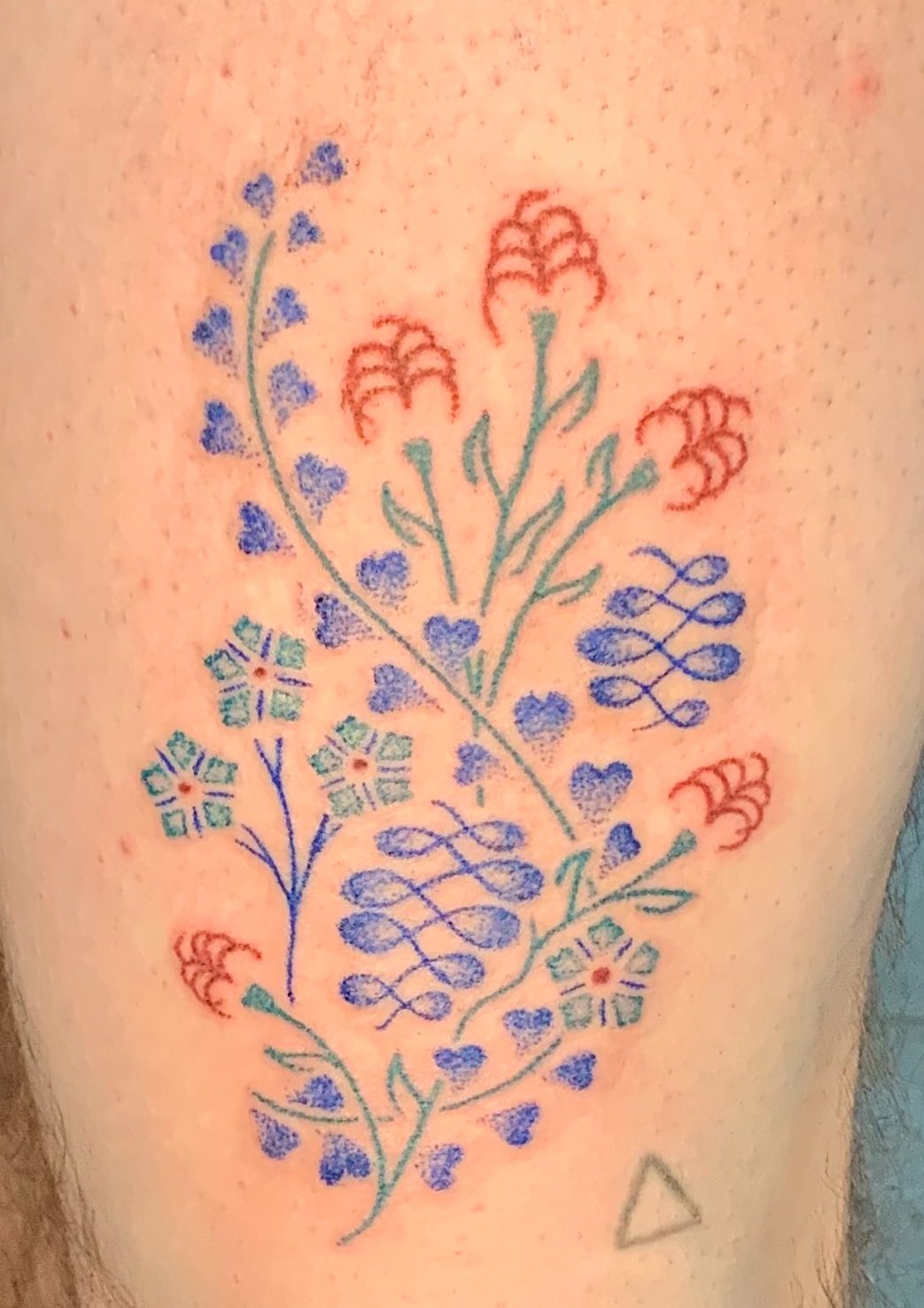
Making informed decisions about colour tattoos requires an understanding of the composition, behaviour, and application of colour ink in the skin.
Tattoo dermatology 101: Part ii
There’s something undeniably enticing about colour tattoos. They are vibrant, bold, and certainly stand out in the sea of black and grey tattoos. Colour is new and unpredictable; subjective and natural. Colour inspires choice, individuality, and chaos.

“Colour is a lapse into decadence and a recovery of innocence, a false addition to a surface and the truth beneath that surface. Colour is disorder and liberty; it is a drug, but a drug that can intoxicate, poison or cure. Colour is all of these things, and more besides, but very rarely is colour just neutral.”
David Batchelor, Chromophobia
But these things that make colour beautiful, also make it intimidating—and colour tattoos are no exception.
Beyond our greater cultural fear of colour, there are lots of practical reasons why people hesitate to get colour tattoos, such as:
- “Colour tattoos are more expensive”
- “They hurt more”
- “Colour inks are toxic”
- “They fade faster and don’t age well”
- “They don’t show up on all skin tones”
Each of these common concerns can be a valid reason to avoid colour tattoos, but the reality is not as simple. Addressing all these rumours is beyond the scope of this blog post, so check out the Colour Tattoos resource page to unpack them.
Our goal here is to establish a baseline understanding of colour ink at the dermatological level. Whether you are an artist seeking to design better tattoos for your clients or a tattoo-getter looking to get educated about your ink, making informed decisions about colour tattoos requires an understanding of the composition, behaviour, and application of colour ink in the skin.
Composition:
What exactly makes colour ink different?
Black ink is fundamentally simpler than colour tattoo inks. Carbon black is a smaller molecule that does not break down over time as much as other pigments do. It’s commonly found in nature, impressively uniform in size and shape, and is not composed of potentially toxic materials.
However, compositional characteristics each have their own effects on our skin’s ability to heal and retain tattoos. Therefore, understanding ink composition can help us to predict how our skin will react to certain pigments over time.
Pigment Size & Consistency:
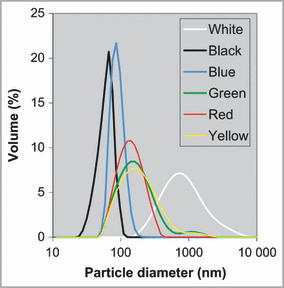
When examining colour tattoo inks under a microscope, we can identify what pigment sizes most commonly occur, and how much the other ink particles in the same sample vary from that size.
For example, the pigments in blue and black inks are small compared to other colours, and there is very little variation from this point.
On the other hand, the pigments in white tattoo inks are generally much larger. Not only are most particles relatively big, but there is much more variation in particle size and how frequently such differences occur within a given sample.
One of the main reasons that our skin retains ink, instead of ejecting it when it evokes our foreign body response, is because the pigments are too small to manoeuvre without engulfing them into dermal cells (read the previous post on tattoo dermatology 101 for a review). As such, the smaller pigments are more easily retained, whereas the larger pigments are more easily flushed out during the healing and aging processes.
Chemical Make-up:
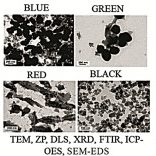
Tattoo inks are a combination of insoluble chemical pigments and the liquid medium that suspends them.
Carrier solutions are often comprised of distilled water, witch hazel, alcohol, and glycerin.
Pigments can be roughly divided into two categories:
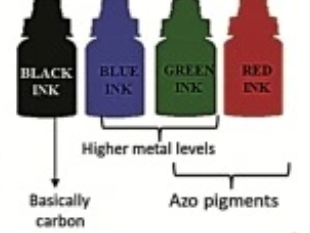
- Inorganic pigments: Carbon Black, Iron Oxides (red, yellow, and brown), Titanium Dioxide (white), Chromium Oxide (Green), Cobalt and Zinc based molecules (green, blue, purple), mercury sulfide (red), cadmium (yellow, orange, red).
- Organic pigments: Polycyclic (green, blue, purple) & azo pigments (usually yellow to red spectrum)
Many inorganic pigments contain heavy metals, which can be arguably carcinogenic, increase blood toxicity, and cause allergic reactions.
To avoid heavy metals, azo pigments have become more prevalent in tattoo inks across the colour spectrum, though they have not fully replaced heavy metals.
Azo pigments are particularly sensitive to photodecomposition under UV light, and their byproducts often cause allergic reactions long after the tattoo is officially healed.
Behaviour:
How do colours behave differently in the skin?
Since ink pigments have different compositional features, they have corresponding behaviours that can help us predict how colour tattoo designs will change as we age.
Many reasons can cause the appearance of tattoos to change over time, such as exposure to solar radiation, pigment metabolism, or the weakening of skin’s collagen network that occurs as we age, to name a few.
While today only one pigment is used for black tattoo ink, there are hundreds of pigments that can create colour tattoos. Therefore, not all inks of a certain colour will contain the same pigment molecules and be subject to the same changes. Nevertheless, there are some behaviours that can generally be associated with the type of pigments commonly found in the inks of a particular colour.
The following table is an incomplete guide to some of these common behavioural associations, and (when relevant) the pigments that cause them:
| Pigment | Colour | Behaviour | Explanation | Source |
| Titanium Dioxide | white (added to “brighten” many other colours) | loses vibrance or fades quickly during aging | Due to their large size and size inconsistencies, a wider range of radiation frequencies can trigger photo decomposition | Shreider et al 2017 |
| – | White and yellow | loses vibrance or fades significantly during healing | Larger pigments and inconsistent sizes result in inconsistent retention of fewer pigments during healing | Baumler 2015 |
| Large Azo pigments | yellow-red | fades quickly during aging | Sensitive to UV light triggered photo-decomposition (breakdown due to solar radiation) | Engel et al, 2009 Maarouf 2019 |
| Cadmium based pigments | Yellow | fades or disappears during healing | Metabolization of the molecule to a soluble form allows it to exit via the lymphatic system | Cui 2005 |
| Iron Oxide, red azo pigments | Red | spreads slightly during healing or aging | Inflammation due to allergic reaction causes additional skin cells to absorb ink it wouldn’t access otherwise | Jacob, 2002 |
| Azo pigments | Red | itchiness during healing and afterwards | Allergic reaction caused by the byproducts breakdown of pigments | Forbat et al 2016 Engel et al 2009 |
| – | Red | raised skin | initial or ongoing allergic reaction resulting in increased scar tissue formation | Jacob et al 2002 Forbat et al 2016 |
| Iron Oxide | Red, Brown | swelling, dermatitis, cornification, necrosis | Serious potential reactions which only occur in allergic responses to Iron based tattoo inks | Dahne et al 2015 Forbat et al 2016 Engel et al 2009 |
| – | Red | fades quickly, especially after sun damage | Melanin does not effectively shield against the frequencies of solar radiation that break down particles in this colour range | Bettertattooing Twig et al 2015 |
| Cobalt based pigments | Blue, some purples | Fades during initial healing while holdsing shape over time | Slow release of cobalt disrupts macrophages abilities, causing slower/reduced uptake during healing, but also a slower release of pigments during the release-recapture cycle | Devcic et al 2022 |
| Cobalt and Zinc based pigments | Blue | Shifts towards green over time | breakdown of heavy metals results in altered molecule than appears greener | Regensburger et al 2011 Serup et al 2015 |
| – | Blue | lasts longer and remains more contained than other colours | smaller and more uniform pigment sizes in both organic and inorganic blue pigments are readily absorbed and do not decompose as easily | Hogsberg et al, 2011 Baumler 2015 |
| Chromium Oxide | Green | Shift towards blue over time | breakdown of heavy metals results in altered molecule that appears more blue | Serup et al 2015 Bauer et al 2020 |
| – | Green | Colour shift, fading during healing, inconsistent spreading | There is significant variability in the absorption rate of green ink | Clarke Beute, 2008 |
| Polycyclic pigments | Green, Blue, Purples | Spreading, skin depressions or texture changes | High absorption of UV radiation affects skin integrity | Regensburger, 2010 |
| – | Black | Shift towards blue/green over time | Usually in older tattoos (pre-1980s) in which heavy metal fillers contaminated the composition of black inks. | Battistini 2020 Serup et al 2015 |
Application:
Knowing common behaviours of colour inks, how can we factor this in to the design process?
Even without knowing the scientific explanations behind colour ink phenomena, artists have discovered in their own practices how to design colour tattoos that age consistently and predictably.
Artists’ tips:
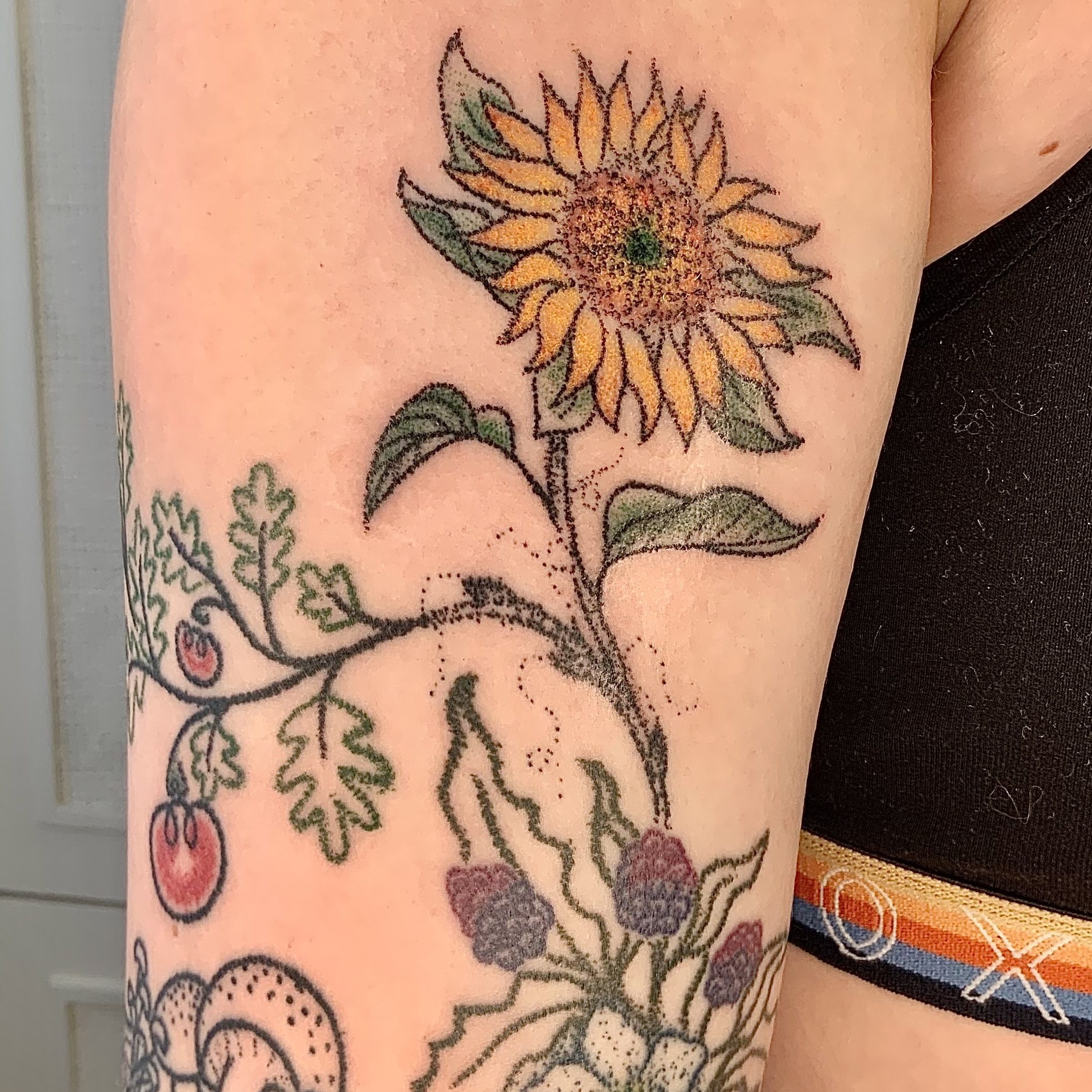
“Black lines with colour fill are consistent and reliable”
Every American Traditional tattoo artist will tell you this is what makes their style “timeless”
As per the science, black ink can provide a reliable outline that maintains the legibility of a design even if the colour fades
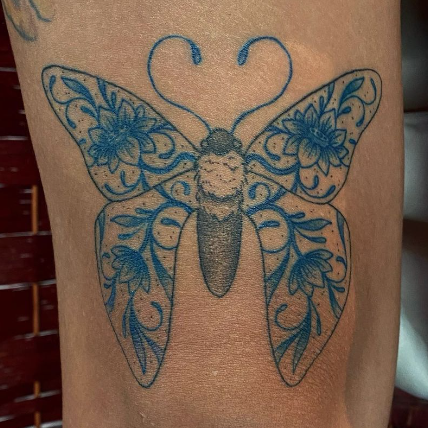
“Apply black and blue first–white and yellow last”
Tattoo the smaller pigments first to reduce the risk of these dark pigments ending up where they don’t belong and overpowering the lighter colours that the skin doesn’t retain as easily
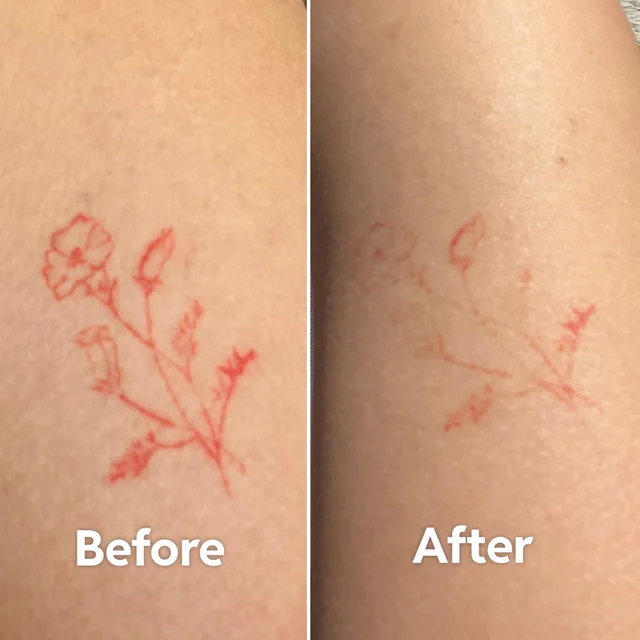
“For unlined, full colour pieces, leave room for the ink to spread”
Think of it like pottery glazes going through the kiln— make sure the elements have room to breathe so that if they change over time, the design remains discernable

“Red tattoos are risky”
They cause most allergic reactions, are prone to spreading, and fade quickly when exposed to the sun. Since they also cause delayed hypersensitivity, it’s difficult to know if they will cause an allergy even if tested before tattooing.
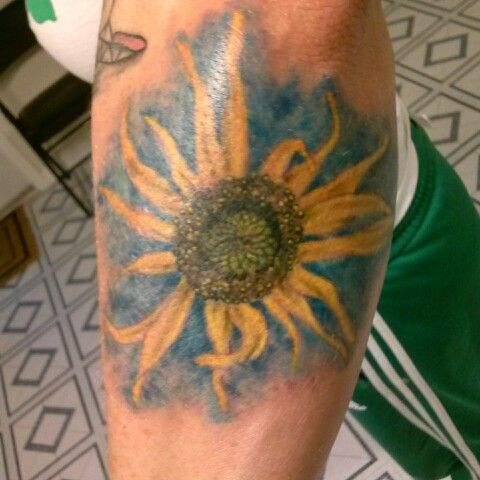
“Don’t rely on colours to produce consistent contrast”
Since they can each age at different rates, they can blur together or decrease the contrast of critical design elements. Complementary colours can even spread together and create a muddy grey or brownish appearance
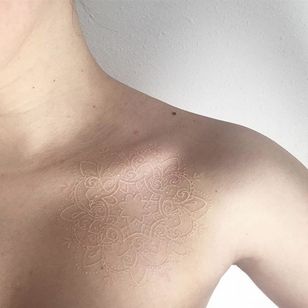
“White ink tattoos might as well be temporary”
They fade very fast, no matter how well they are executed. But hey– they can make for a reliably temporary tattoo and are great for layering or blastover work
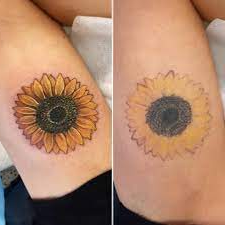
“Don’t depend on yellow, green, or red for line work”
Their inconsistencies tend to be unreliable carriers for a design’s main outline, and can be overpowered by the darker pigments they are trying to contain
.png)
“Understand how undertones affect healed appearance”
Don’t be afraid to alter the colours of a design slightly in order to make it appear well in each client’s skin tone.
It comes with experience, and other write about it extensively:
“Diluting with distilled water is different than diluting with white”
White pigments are usually added to brighten other colours, so blending with white means lightening the tone of other hues, not making them more transparent.
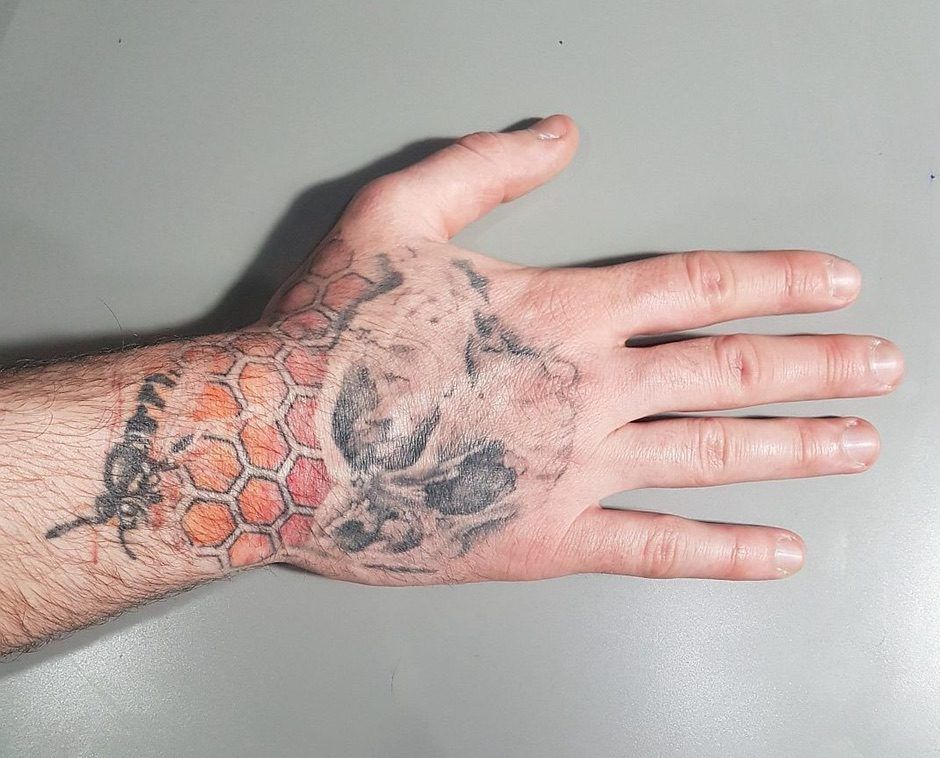

“Sunscreen is your best friend”
Across the board, all inks are harmed most by solar radiation causing them to break down over time. Wear sunscreen to preserve their original colour and shape.
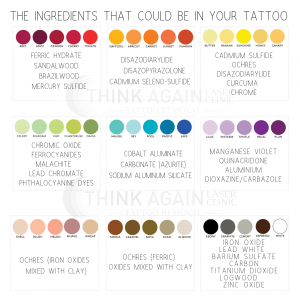
“Know what’s in your ink”
Never use inks that don’t have their ingredients listed out, otherwise if you react to it, there’s no way to determine the source.
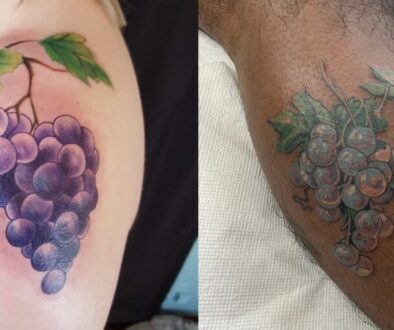
“Don’t be racist”
If you can’t adjust your colour palette to work well on all skin tones, you’re bad at tattooing. ¯\_(ツ)_/¯

 Andy Pollard